
ISRAEL IN BIBLE PROPHECY | home
INDEX | DANIEL'S BEASTS | DANIEL'S "TIMES" PROPHECIES | LBL | ANTICHRIST | JOHN'S EIGHT BEASTS | JOHN'S 1260 "DAYS" | BEAST 42 "MONTHS" | 666 | THE ABOMINATION OF DESOLATION | GENTILE 42 "MONTHS" | 69 WEEKS | DANIEL'S 1290 "DAYS" | DANIEL'S 1335 "DAYS" | FIG TREE | SOME JEWS BLINDNESS TO THE GOSPEL | TWO WITNESSES | THAT MAN OF SIN | CHRISTIAN POLYTHEISM | ISLAM, DECEPTION, AHMED DEEDAT, AND TAQIYYAH | NOT THE SAME GOD | LAMB SLAIN | THE STRONG DELUSION | DEEDAT, ISLAM, HITLER AND HATE | APOLOGY TO MUSLIMS | ISLAMIC HATRED OF JEWS | ISLAM AND FRIENDSHIP | ISLAMIC JIHAD | THE TEMPLE OF GOD | THE BEAST OF REVELATION 13 | TEXTUAL INTEGRITY - BIBLE VS QURAN | NEW COVENANT | ISLAM: THE PERFECT OPPOSITE | MOHAMMED'S HEAVEN | ISLAM AND SCRIPTURE | ISLAM 101. | CHURCH TRADITION | QURAN & ABROGATION | THE NAME ALLAH | GAZA | QURAN INSPIRATION | YHWH MANIFEST | BANU QURAYZA MASSACRE | JIHAD | JESUS' CRUCIFIXION IN PROPHECY | THE SCRIPTURES WERE CORRUPTED | THE PALE HORSE | YAHWEH YAHSHUA | OLD TESTAMENT VIOLENCE | ZIONISM | Anti-Zionism & Anti-Zionists
THE ABOMINATION OF DESOLATION
You have arrived in the presentation section. For a more in-depth discussion of these subjects please click here.
Matthew 24:15 When ye therefore shall see the abomination of desolation, spoken of by Daniel the prophet, stand in the holy place, (whoso readeth, let him understand:) 16 Then let them which be in Judaea flee into the mountains
It would be difficult for a Christian to deny that the blasphemous Islamic Mosque, the Dome of the Rock, is AN abomination with it's mosaic declarations of "God is only One God. Far be it removed from His transcendent majesty that He should have a son." and "God, Who hath not taken unto Himself a son". That is, of course, the exact opposite of what the Gospel teaches through hundreds of verses that confirm Jesus is the Son of God and God His Father, such as....
John 3:16 For God so loved the world, that he gave his only begotten Son, that whosoever believeth in him should not perish, but have everlasting life.
When a Muslim confesses that Jesus Christ is the Son of God he has committed the most egregious, and only unpardonable, sin in Muhammad's stand-alone 7th century religion.
1John 4:15 Whosoever shall confess that Jesus is the Son of God, God dwelleth in him, and he in God.
Confessing that Jesus is the Son of God transgresses the single most important element in Islam and is known as "_ylt=A0geu61xYLVHeVIAI7lXNyoA?p=shirk+islam+god+no+son&fr=yfp-t-501&ei=UTF-8shirk", but by Christians is identified as coming from the spirit of antichrist.
1 John 2:22 Who is a liar but he that denieth that Jesus is the Christ? He is antichrist, that denieth the Father and the Son. 23 Whosoever denieth the Son, the same hath not the Father: [(but) he that acknowledgeth the Son hath the Father also].
There is certainly no shortage of Jews in Israel that consider the Dome of the Rock to be an abomination of desolation as any worship on the temple mount is precluded by the existence of this Islamic abomination, with the Muslim leaders even declaring the temple mount a "no prayer zone". The Israelis regained control of the temple mount in the 7 day war, but were later forced to negotiate it away to the Muslims.
Muhammad wholesale slaughtered Jewish farmers, abused and enslaved their wives and children, and stole their property, and his hatred of Jews is expressed throughout Islam's books as in this example from Islam's Hadith:
Narrated 'Abdullah bin 'Umar: Allah's Apostle said, "You (i.e. Muslims) will fight wi the Jews till some of them will hide behind stones. The stones will (betray them) saying, 'O 'Abdullah (i.e. slave of Allah)! There is a Jew hiding behind me; so kill him.”
Amazingly, the only claim that Islam has to Jerusalem whatsoever, comes from a story that Muhammad told wherein he declared that he rode on a flying animal one night from Mecca, to Jerusalem where he claimed that he had prayed in a temple that had been torn down over 500 years previously, then went on a leg of his journey up to "paradise" to meet with Adam, Abraham, Moses, Jesus and others, then rode his flying donkey/mule back to Mecca by morning!
But could the blasphemous Islamic structure on the temple mount be THE abomination of desolation "spoken of by Daniel the prophet" that was "set up" (or "placed") to "stand" in the holy place?
Daniel 12:11 And from the time [that] the daily [sacrifice] shall be taken away, and the abomination that maketh desolate set up, [there shall be] a thousand two hundred and ninety days.
(Tanach) - Daniel 12:11 And from the time the daily sacrifice was removed and the silent abomination placed, is one thousand, two hundred, and ninety.
Mark confirms it to be "standing" and tells us that the abomination is an "it":
Mark 13:14 But when ye shall see the abomination of desolation, spoken of by Daniel the prophet, standing where it ought not, (let him that readeth understand,) then let them that be in Judaea flee to the mountains:
Luke writes that it is Jerusalem that is desolated, in his parallel verse:
Luke 21:20 And when ye shall see Jerusalem compassed with armies, then know that the desolation thereof is nigh 21 Then let them which are in Judaea flee to the mountains...
All three apostles write about it in the future tense as "... ye shall see...", so we can conclude that it was to be an abomination, associated with the desolation of Jerusalem, that was to be in the future of when Jesus delivered this discourse, even though the abomination was spoken of by Daniel the prophet over 500 years prior to the discourse.
Jerusalem was compassed with armies on many occasions after the discourse including 70 AD, 132, 639, 1099, 1187, 1948, 1967 and unto today. In 70 AD, a million Jews were killed, and an apparently already desolate temple was torn down. Jesus had declared to the Pharisees almost 40 years earlier: Matt 23:33 [Ye] serpents, [ye] generation of vipers, how can ye escape the damnation of hell? Then in Matt 23:38 "Behold, your house is left unto you desolate.", because the they had made "...the word of God of none effect through your tradition..." (Mark 7:13), a condition familiar to today's church.
If the temple had not already been rendered desolate, then surely it was through the completed work of Jesus' shed blood on the Cross, almost 40 years before the temple was torn down. That is likely why "...the veil of the temple was rent in twain from the top to the bottom..." after Jesus had "...yielded up the ghost..." on the Cross (Matt 27:50-51). Additionally, in 70 AD all of the Christians escaped and were saved out of the slaughter which suggests that it did not desolate the Christian community.
Though the events of 70 AD were horrific, the Roman Gentiles slaughtered another 600-750,000 Jews less than 65 years later, in the Bar Kocha revolt of 132-135 AD.
Later in the Olivet Discourse we learn:
Luke 21:24 And they shall fall by the edge of the sword, and shall be led away captive into all nations: and Jerusalem shall be trodden down of the Gentiles, until the times of the Gentiles be fulfilled.
After Luke gave us a time pin of "Jerusalem compassed with armies" he later offers another pin of the "times of the Gentiles" fulfilled. It would seem problematic indeed to suggest that the "times of the Gentiles" were fulfilled in 70 AD considering the Roman Gentiles double dip of Jewish slaughter less than 65 years later.
Blessedly, as Daniel's "times" problems confirm - both mathematically and textually - the "times of the Gentiles" were fulfilled in 1967 when the Jews were restored to power over Jerusalem. We read "... when he shall have accomplished to scatter the power of the holy people..." - 1967 marked the end of the scattered power of the Jews (the only "holy people" of Daniel's day).
Jerusalem was temporarily desolated in 70 AD, and again in 132 AD, then conquered again in 639 AD when Khalifah Omar marched into town during the Islamic First Jihad. The Coptic church was alive and well since Khalifah Omar compelled Bishop Sophronius to show him around town.
However, history has shown that nothing was more desolating to Jerusalem than 1100 years of Islamization through the exile of Christians and Jews. As a result the historical record of Jerusalem in first quarter of the 19th century is sketchy and anecdotal at best.
In "A History of the Jews" Paul Johnson writes on page 321: "Between 1827 and 1839, largely through British efforts, the population of Jerusalem rose from 550 to 5,500 and in all Palestine it topped 10,000 - the real beginning of the Jewish return to the Promised Land. In 1838 Palmerston appointed the first western vice-consul in Jerusalem, W.T. Young, and told him 'to afford protection to the Jews generally'."
Even as late as 1867 Mark Twain described it thus: “ ...[a] desolate country whose soil is rich enough, but is given over wholly to weeds-a silent mournful expanse....A desolation is here that not even imagination can grace with the pomp of life and action....We never saw a human being on the whole route....There was hardly a tree or a shrub anywhere. Even the olive and the cactus, those fast friends of the worthless soil, had almost deserted the country.”
When we read: Matt 24:16 Then let them which be in Judaea flee into the mountains... it becomes pretty clear that this would apply to all of the compassings of Jerusalem, but the historically confirmed desolation of Islam, symbolized by the Dome of the Rock, is further supported when we consider the text and math of: (KJV) Revelation 12:6: And the woman fled into the wilderness, where she hath a place prepared of God, that they should feed her there a thousand two hundred [and] threescore days.
It was 1260 "days" (as years) of Jewish and Christian exile, from the founding of the Dome of the Rock in 688, until the declaration of an independent Israel in 1948. It was 42 prophetic "months" from 688 to 1967 as the Islamic beast continued. The date of 688 is also confirmed mathematically and textually by Daniel's 1290 "days", and the 1290 is confirmed by his 1335.
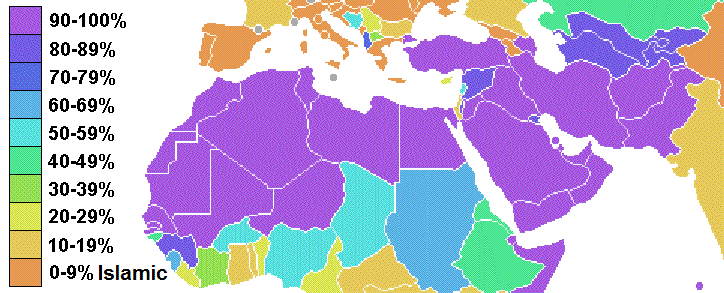
Within this traditional historicist approach it is easy to understand that the Islamic Mosque, the Dome of the Rock, is THE abomination of desolation that was "set up" and is "standing where it ought not" on the temple mount. Indeed desolation of the mount is the order of the day through Islamic prohibition of prayer, and the bringing of "Holy objects" like bibles, onto the mount.
The "man of sin" of 2 Thessalonians is not a very good fit as John Nelson Darby contended, since he "sitteth" in the "temple of God", and is not an "it". Nor would the Roman army of the conflagration of 70 AD seem a good fit by definition, particularly since that was not desolating in regard to the Christians survival, and the temple was desolated almost 40 years before at the Cross. The Dome of the Rock, on the other hand, seems a very apt symbol for Islam as the subject of the end - the final kingdom that oppresses God's people - just as we see it "stand" in the holy place, on the holy hill today. We can also see Islamic desolation of 53 countries in these times, with two million slain in the Sudan alone. Indonesia is only 50% Muslim yet the Bible is banned and all religious material must be Islamic in nature.
Our Lord and Savior's return may truly be at hand when we consider: Matthew 24:32-34 Now learn a parable of the fig tree; When his branch is yet tender, and putteth forth leaves, ye know that summer [is] nigh: 33 So likewise ye, when ye shall see all these things, know that it is near, [even] at the doors. 34 Verily I say unto you, This generation shall not pass, till all these things be fulfilled.
The times of the Gentiles is one of the last of the "things" on the list to be fulfilled before the return of our Savior. The same generation that sees all "these things" in this passage fulfilled, will not pass before Jesus' return. Whether a biblical, literal or metaphorical generation is meant is uncertain. But if the shortest possible time span is considered, enough bible prophecy has been fulfilled for Jesus to return .... TODAY!
Please visit:
israelinbibleprophecy.com
beholdthebeast.com
the abomination - Check Strong's here
New Testament Greek Definition:
946 bdelugma {bdel'-oog-mah}
from 948; TDNT - 1:598,103; n n
AV - abomination 6; 6
1) a foul thing, a detestable thing
1a) of idols and things pertaining to idolatry
of desolation Check Strong's here
New Testament Greek Definition:
2050 eremosis {er-ay'-mo-sis}
from 2049; TDNT - 2:660,255; n f
AV - desolation 3; 3
1) a making desolate, desolation
desolate - Check Strong's here
New Testament Greek Definition:
2048 eremos {er'-ay-mos}
of uncertain affinity; TDNT - 2:657,255; adjective
AV - wilderness 32, desert 13, desolate 4, solitary 1; 50
1) solitary, lonely, desolate, uninhabited
1a) used of places
1a1) a desert, wilderness
1a2) deserted places, lonely regions
1a3) an uncultivated region fit for pasturage
1b) used of persons
1b1) deserted by others
1b2) deprived of the aid and protection of others,
especially of friends, acquaintances, kindred
1b3) bereft
1b3a) of a flock deserted by the shepherd
1b3b) of a woman neglected by her husband,
from whom the husband withholds himself
stand - Check Strong's here
New Testament Greek Definition:
2476 histemi {his'-tay-mee}
a prolonged form of a primary stao {stah'-o} (of the same
meaning, and used for it in certain tenses); TDNT - 7:638,1082; v
AV - stand 116, set 11, establish 5, stand still 4, stand by 3,
misc 17, vr stand 2; 158
1) to cause or make to stand, to place, put, set
1a) to bid to stand by, [set up]
1a1) in the presence of others, in the midst, before judges,
before members of the Sanhedrin;
1a2) to place
1b) to make firm, fix establish
1b1) to cause a person or a thing to keep his or its place
1b2) to stand, be kept intact (of family, a kingdom), to escape
in safety
1b3) to establish a thing, cause it to stand
1b31) to uphold or sustain the authority or force of anything
1c) to set or place in a balance
1c1) to weigh: money to one (because in very early times before
the introduction of coinage, the metals used to be weighed)
2) to stand
2a) to stand by or near
2a1) to stop, stand still, to stand immovable, stand firm
2a1a) of the foundation of a building
2b) to stand
2b1) continue safe and sound, stand unharmed, to stand ready or
prepared
2b2) to be of a steadfast mind
2b3) of quality, one who does not hesitate, does not waiver
in
New Testament Greek Definition:
1722 en {en}
a primary preposition denoting (fixed) position (in place, time or state), and (by implication) instrumentality (medially or constructively), i.e. a relation of rest (intermediate between 1519 and 1537); TDNT - 2:537,233; prep AV - in 1874, by 141, with 134, among 117, at 112, on 46, through 37, misc 321; 2782
1) in, by, with etc.
Wigram's frequency count is 2799 not 2782.
set up - Check Strong's here
Old Testament Hebrew Definition:
05414 nathan {naw-than'}
a primitive root; TWOT - 1443; v
AV - give 1078, put 191, deliver 174, made 107, set 99, up 26, lay 22,
grant 21, suffer 18, yield 15, bring 15, cause 13, utter 12,
laid 11, send 11, recompense 11, appoint 10, shew 7, misc 167; 2008
1) to give, put, set
1a) (Qal)
1a1) to give, bestow, grant, permit, ascribe, employ, devote,
consecrate, dedicate, pay wages, sell, exchange, lend,
commit, entrust, give over, deliver up, yield produce,
occasion, produce, requite to, report, mention, utter,
stretch out, extend
1a2) to put, set, put on, put upon, set, appoint, assign,
designate
1a3) to make, constitute
1b) (Niphal)
1b1) to be given, be bestowed, be provided, be entrusted to, be
granted to, be permitted, be issued, be published, be
uttered, be assigned
1b2) to be set, be put, be made, be inflicted
1c) (Hophal)
1c1) to be given, be bestowed, be given up, be delivered up
1c2) to be put upon
This
New Testament Greek Definition:
3778 houtos {hoo'-tos} including nominative masculine plural
houtoi {hoo'-toy}, nominative feminine singular haute {how'-tay}
and nominative feminine plural hautai {how'-tahee}
from the article 3588 and 846;; pron
AV - this 157, these 59, he 31, the same 28, this man 25, she 12,
they 10, misc 34; 356
1) this, these, etc.
generation - Check Strong's here
New Testament Greek Definition:
1074 genea {ghen-eh-ah'}
from (a presumed derivative of) 1085; TDNT - 1:662,114; n f
AV - generation 37, time 2, age 2, nation 1; 42
1) fathered, birth, nativity
2) that which has been begotten, men of the same stock, a family
2a) the several ranks of natural descent, the successive
members of a genealogy
2b) metaph. a group of men very like each other in endowments,
pursuits, character
2b1) esp. in a bad sense, a perverse nation
3) the whole multitude of men living at the same time
4) an age (i.e. the time ordinarily occupied be each successive
generation), a space of 30 - 33 years